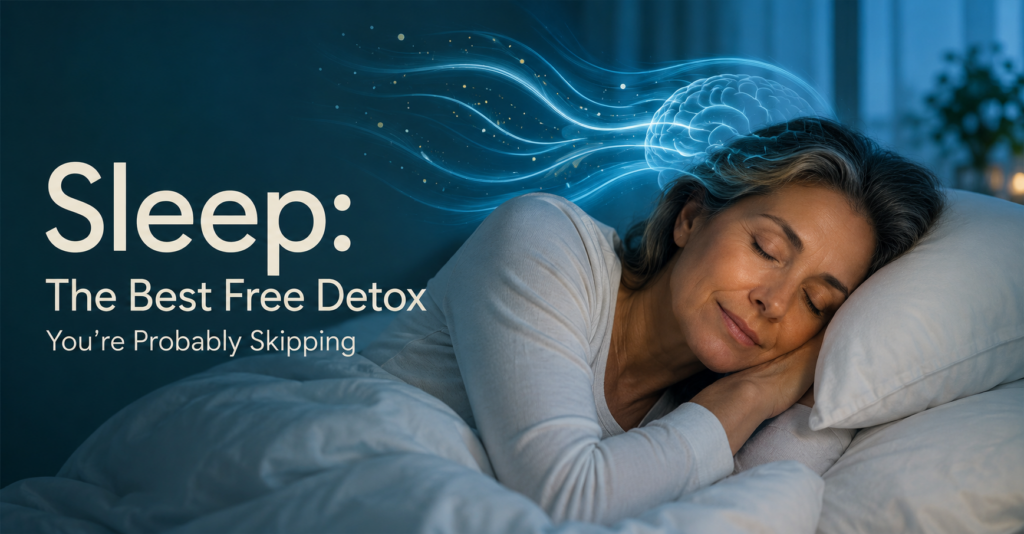
Sleep: The Best Free Detox You’re Probably Skipping
Let’s be honest, when you hear the word “detox,” you probably picture a green juice cleanse, not lying in bed doing absolutely nothing. But here’s the plot twist: your best, cheapest, most effective detox happens every single night, for free, while you’re unconscious. You just have to actually let it happen.
So let’s talk about what’s really going on while you sleep — and why blowing it off is a bigger deal than it feels like at 11:47 pm when you’re “just finishing one more episode.”
Your Brain Runs a Night Shift
It turns out your brain doesn’t clock out when you do. During deep sleep, it activates the glymphatic system. Think of this system as your brain’s overnight cleaning crew, sweeping out metabolic junk (including a protein called beta-amyloid, linked to cognitive decline). Your brain cells literally shrink a bit to make room for the crew to get through.
When you skip deep sleep, the crew doesn’t show up. The mess sits there. If you do that often enough, it starts showing up as brain fog, that “where did I put my keys” feeling, and a nervous system that never quite catches its breath.
Sleep Isn’t One Long Nap — It’s a Cycle
Every night, you cycle through roughly 90-minute rounds of light sleep, deep sleep, and REM sleep, and each one has its own job:
- Light sleep — the on-ramp, plus some physical repair
- Deep sleep — glymphatic detox, tissue repair, growth hormone release
- REM sleep — memory filing, emotional processing, dreaming
This is why “I got 8 hours” doesn’t always mean “I feel amazing.” If stress, alcohol, blood sugar swings, or a wired nervous system keep you skipping the deep and REM stages, you can rack up plenty of hours and still wake up feeling like a browser with 40 tabs open.
Meet Your Circadian Rhythm (Your Body’s Internal Clock)
Every cell in your body runs on a built-in 24-hour clock, managed by a control center in your brain called the suprachiasmatic nucleus (SCN). The SCN takes its orders mostly from light, which is why a few minutes of real sunlight in the morning does more for your sleep than another 15-minute snooze. Bright mornings and dim evenings keep your internal clock on schedule.
The SCN also choreographs melatonin (your “time for bed” hormone) and cortisol (your “time to get up” hormone). Keep that rhythm in sync, and falling asleep feels automatic. Throw it off with late nights, endless scrolling, or shift work, and your body genuinely doesn’t know what day or time it is.
What Happens When You Shortchange It
If you skip good sleep for even a few nights, your body notices immediately. Common effects include:
- Cortisol stays elevated — your nervous system gets stuck in “go” mode
- Inflammation creeps up
- Blood sugar and hunger hormones get scrambled (hello, cravings)
- Your immune system takes a hit
- Memory, focus, and patience all take a nosedive
If you want the science-heavy version of all this, the NIH’s overview of sleep basics is a solid, non-salesy read.
Quick FAQ
Is it true I can “catch up” on sleep over the weekend?
Partially. A weekend catch-up nap helps a little, but it doesn’t fully undo a week of short nights, especially the missed deep and REM sleep. Consistency beats a Saturday marathon nap.
Why do I wake up at 2 or 3am and can’t fall back asleep?
Usually a blood sugar dip, a stress-driven cortisol spike, or both. We dig into this more in our next post on what’s actually behind chronic poor sleep.
Does melatonin actually work?
Sometimes, short-term — but it’s a hormone, not a sleeping pill, and it won’t fix a circadian rhythm that’s out of sync or a nervous system stuck in overdrive. It’s a patch, not a root-cause fix.
How much deep sleep do I actually need?
Most adults need roughly 13-23% of total sleep time in deep sleep. A sleep tracker can give you a rough estimate, but how you feel in the morning is still the best gut check.
Where This Goes Next
Next up: we’re breaking down the health conditions linked to chronic poor sleep, and what a real, root-cause fix looks like — no “just try melatonin” allowed. If sleep has felt like a losing battle for longer than you’d like to admit, our Functional Medicine team can help you find out why, instead of just masking it.
Reference
National Institute of Neurological Disorders and Stroke, National Institutes of Health. “Brain Basics: Understanding Sleep.” Retrieved August 2026, from https://www.ninds.nih.gov/health-information/public-education/brain-basics/brain-basics-understanding-sleep.