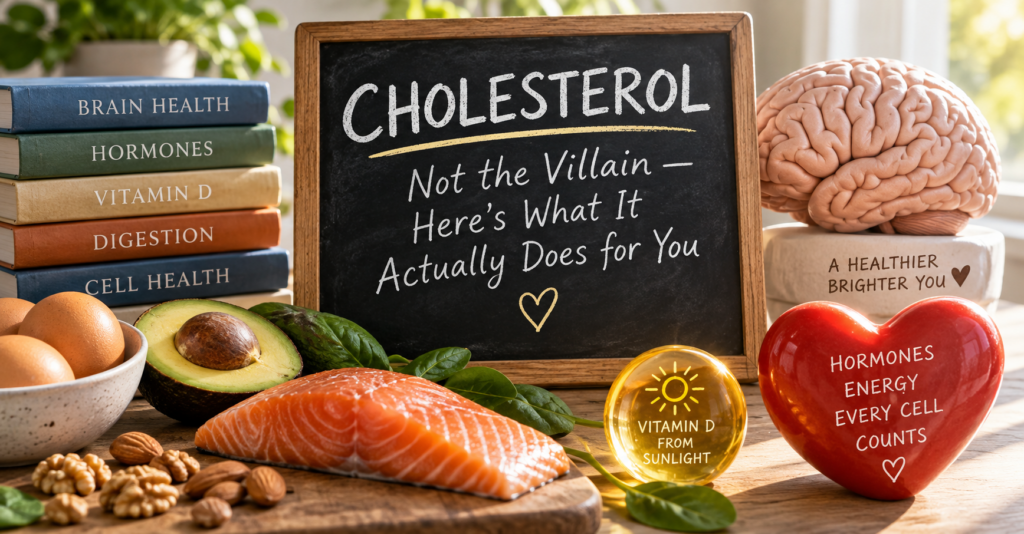
Cholesterol has a reputation problem. Say the word out loud in a doctor’s office, and you can practically feel the room brace for bad news. But here’s what almost never gets said at that appointment: your body isn’t trying to sabotage you. It makes cholesterol on purpose, in serious quantities, because it genuinely cannot run without it.
What Cholesterol Is Actually Doing
Before we talk about what your number should be, it helps to know what the molecule is actually for. This is the short list, and it’s a longer job description than most people expect:
- Your brain. A quarter of the cholesterol in your body lives there, helping build and protect nerve cells.
- Your hormones. Cortisol, estrogen, progesterone, and testosterone are all built from a cholesterol backbone.
- Your vitamin D. Your skin uses cholesterol, plus sunlight, to manufacture it.
- Your digestion. Your liver converts cholesterol into bile, which breaks down the fat you eat.
- Every cell membrane in your body needs it to hold its shape and do its job.
Your liver makes most of your cholesterol on its own, regardless of what’s on your plate, because the job is that important. So the goal was never “as close to zero as possible.” The real goal is understanding why your number looks the way it does — and that’s a very different conversation than the one most people are having. sleep gets ignored as a root cause. The damage builds quietly over months, not one bad night.
Cholesterol Questions We Hear All the Time
Will eating eggs wreck my cholesterol?
For most people, no. Your liver produces the majority of the cholesterol circulating in your blood, and it adjusts its own output based on what you’re eating. Dietary cholesterol has a smaller effect on your labs than a lot of us grew up believing. Eggs are still a solid source of protein and choline, a nutrient your brain uses every day.
Should I just go low-fat?
Usually not the win people expect. When fat comes off the plate, refined carbs and added sugar tend to fill the gap — and that swap can push triglycerides up while pulling your protective HDL down. Real food, healthy fats, fiber, and protein tend to move the needle further than fear of fat ever did.
Can cholesterol be too low?
Yes — and this one surprises people. Some research has linked very low LDL (under roughly 70 mg/dL) to a higher risk of hemorrhagic (bleeding) stroke, particularly in women, which is worth a real conversation with your provider if your numbers run unusually low. Other research on aggressive lipid-lowering below 55 mg/dL hasn’t shown that same signal, and lower LDL still reduces the far more common ischemic strokes — so this isn’t a reason to panic about a low number. It’s a reason to ask questions instead of chasing “lower” blindly.
Which numbers actually matter?
Total cholesterol by itself is a blunt tool — it lumps everything together and misses most of the story. Ask about your triglyceride-to-HDL ratio, ApoB, and hs-CRP, a marker of inflammation. We’ll dig into exactly what those mean, and why they matter more than the number on the summary page, in our next post on triglycerides, inflammation, and gut health.
Want to Know What Your Own Labs Are Really Saying?
That’s exactly the kind of digging we love. Our functional medicine team looks past the reference range to figure out why your numbers look the way they do — not just whether they land inside it. If you’re in the Maitland, FL area and ready for a real answer instead of a shrug, we’d love to talk.
Tension and misalignment in the spine, especially around the neck and upper back, can keep sending your nervous system “stay alert” signals even when there’s nothing to be alert about. Chiropractic adjustments help quiet that noise, making it easier for your body to actually shift into rest mode instead of just lying there willing yourself to sleep.
It’s not a magic fix for insomnia on its own. But paired with the functional medicine work below, it’s often the missing piece for people whose bodies just won’t power down.
Reference
American Academy of Neurology. (2019, April 10). Low cholesterol linked to higher risk of bleeding stroke in women. https://www.aan.com/PressRoom/Home/PressRelease/2714